

California concealed carry laws in 2025 represent a significant evolution in Second Amendment rights following landmark court decisions and legislative changes. Whether you’re a first-time applicant seeking your California CCW permit or an experienced gun owner navigating the state’s complex regulations, understanding the current legal landscape is crucial for lawful concealed carry. This comprehensive guide breaks down everything you need to know about obtaining and maintaining your California concealed carry permit, from application requirements to reciprocity agreements with other states.
The Golden State’s approach to concealed carry has undergone substantial transformation since the Supreme Court’s 2022 Bruen decision, which fundamentally altered how states evaluate concealed carry applications. California residents now enjoy expanded opportunities to exercise their constitutional rights while still navigating one of the nation’s more stringent regulatory frameworks. With proper knowledge and preparation, obtaining your California concealed carry permit is more achievable than ever before.
California CCW At a Glance
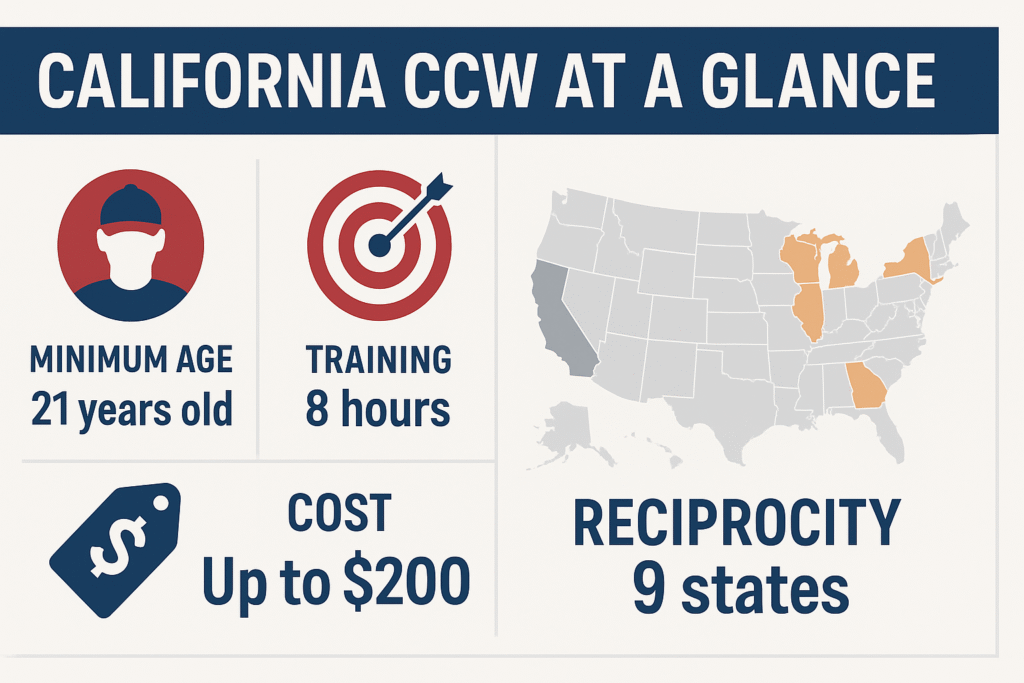
Permit Type: Shall-Issue (Post-Bruen)
Minimum Age: 21 years
Training Required: 16 hours initial / 8 hours renewal
Permit Duration: 2 years
Processing Time: 3-6 months average
Total Cost: $500-$700
Reciprocity: 26 states
Castle Doctrine: Yes
Stand Your Ground: No (limited judicial interpretation)
This guide serves as your complete resource for understanding California’s concealed carry laws, including detailed permit requirements, application procedures, training mandates, and carry restrictions. We’ll explore where you can legally carry, reciprocity agreements with other states, and critical self-defense laws that every permit holder must understand. Whether you’re concerned about personal protection in urban areas or seeking to exercise your rights across the state, this guide provides the authoritative information you need.
Recent statistics show California has experienced a surge in concealed carry applications, with processing times and approval rates varying significantly by county. Understanding these regional differences, along with statewide requirements, positions you for success in obtaining your permit. We’ll address common misconceptions, highlight potential pitfalls, and provide practical strategies for navigating the application process efficiently.
By the end of this guide, you’ll have a thorough understanding of California concealed carry laws, know exactly how to apply for your permit, understand where you can legally carry, and be prepared to exercise your rights responsibly. Let’s begin with the fundamental requirements every California resident must meet to obtain their concealed carry permit.
California Concealed Carry Permit Requirements
Understanding California concealed carry permit requirements is the first step toward legally carrying a concealed firearm in the Golden State. California operates as a “shall-issue” state following the Bruen decision, meaning authorities must issue permits to qualified applicants who meet established criteria (Cal. Pen. Code § 26150). However, the state maintains specific requirements that all applicants must satisfy before receiving their CCW permit.
Age Requirements
California law requires concealed carry applicants to be at least 21 years of age. This age requirement applies uniformly across all counties and cannot be waived for any reason, including military service. Unlike some states that allow provisional permits for younger applicants, California maintains a strict 21-year minimum age for all concealed carry permits. Applicants must provide valid proof of age through government-issued identification during the application process.
Residency Requirements
California concealed carry permits are available to both residents and non-residents, though the application process differs slightly. California residents must apply in their county of residence and provide proof of residency such as a driver’s license, utility bills, or lease agreements. The issuing authority will verify your address, and any discrepancies can delay or derail your application.
Non-residents may apply for a California CCW permit if they have a principal place of employment or business in the state. These applicants must provide documentation proving their business connection to California, such as employment verification letters or business licenses. Non-resident permits follow the same training and qualification requirements as resident permits.
Background Check Requirements
All California concealed carry applicants undergo comprehensive background checks conducted by the Department of Justice. These checks include fingerprint-based criminal history reviews at both state and federal levels. The background investigation examines criminal history, mental health records, restraining orders, and other factors that might disqualify an applicant.
Applicants must submit to LiveScan fingerprinting at an approved location, with fees typically ranging from $70 to $100 depending on the provider. Background check services process these submissions electronically, usually completing initial reviews within 30 days. Any criminal convictions, certain misdemeanors, or prohibiting factors discovered during this process will result in denial.
Training Requirements
California mandates specific training requirements for all concealed carry permit applicants. The state requires completion of an approved firearms safety course that covers California firearms laws, safe handling procedures, and live-fire qualification. Training must be conducted by state-approved instructors and include both classroom and range components.
The training requirement includes a minimum of 16 hours of instruction for initial permits, covering topics such as firearms safety, California gun laws, conflict de-escalation, and use of force principles. Renewal training requires 8 hours of instruction every two years. Many applicants find that investing in quality concealed carry training courses beyond the minimum requirements better prepares them for responsible carry.
Disqualifying Factors
Several factors can disqualify an applicant from obtaining a California concealed carry permit. Felony convictions result in lifetime prohibition from firearms ownership under both state and federal law. Certain misdemeanor convictions, including domestic violence offenses, also create prohibitions that prevent permit issuance.
Mental health prohibitions apply to individuals who have been involuntarily committed to mental health facilities or deemed mentally incompetent by a court. Active restraining orders, particularly those involving domestic violence or credible threats, disqualify applicants during the order’s duration. Substance abuse issues, including certain drug convictions or documented alcohol abuse, may also result in denial.
Other disqualifying factors include dishonorable military discharge, renunciation of U.S. citizenship, and being subject to certain court orders. California law also allows issuing authorities to consider an applicant’s moral character, though post-Bruen decisions have limited subjective denials. Understanding these disqualifying factors before applying can save time and application fees.
How to Apply for a California Concealed Carry Permit
The California concealed carry application process requires careful attention to detail and proper documentation. While procedures may vary slightly by county, the fundamental steps remain consistent statewide. Understanding each phase of the application process helps ensure smooth progression from initial submission to permit issuance.
Where to Apply
California residents must apply for their concealed carry permit through their county sheriff’s office or, in some cases, their local police chief. The issuing authority depends on your place of residence – unincorporated areas fall under sheriff jurisdiction, while city residents may apply through either the sheriff or police chief, depending on local policies. Contact your local law enforcement agency to determine the appropriate issuing authority for your area.
Many counties now offer online application portals that streamline the initial submission process. These systems allow applicants to complete forms, upload documents, and schedule appointments electronically. Counties without online systems typically require in-person submission of paper applications during designated business hours.
Required Documents
Successful California CCW permit applications require comprehensive documentation. Primary requirements include valid government-issued photo identification, proof of residency, and completed application forms specific to your issuing authority. Most agencies require multiple forms of residency proof, such as utility bills, bank statements, or property tax documents dated within the last 90 days.
Additional documentation includes training certificates from approved instructors, LiveScan fingerprinting receipts, and any supporting documents related to your good cause statement (though post-Bruen, specific threats are no longer required). Military veterans should include discharge papers (DD-214), while business owners applying based on their work location need business licenses or employment verification. Some counties require passport photos, while others take photographs during the application appointment.
Application Fees
California concealed carry permit fees vary by county but typically range from $150 to $300 for initial applications. This base fee covers administrative processing but doesn’t include additional costs such as fingerprinting, training, or psychological evaluations if required. LiveScan fingerprinting adds approximately $70-100, while training courses range from $150-400 depending on the provider and location.
| Fee Type | Cost Range | Notes |
|---|---|---|
| Application Processing | $150-$300 | Varies by county |
| LiveScan Fingerprinting | $70-$100 | One-time fee |
| Training Course | $150-$400 | 16 hours required |
| Psychological Evaluation | $150 | If required |
| Total Initial Cost | $520-$950 | Budget $700 average |
Payment methods vary by agency, with most accepting cash, checks, money orders, or credit cards. Some agencies require separate payments for different application phases, while others collect all fees upfront. Document preparation services can assist with organizing applications, though these add additional costs.
Processing Times
California concealed carry processing times vary significantly by county and current application volume. State law requires issuing authorities to complete investigations within 90 days of receiving a complete application, though some counties routinely exceed this timeframe. Urban counties with high application volumes may take 6-12 months, while rural counties often process applications within 60-90 days.
The process typically includes initial application review, background check completion, interview scheduling, and final approval stages. Agencies must notify applicants of incomplete applications within 30 days, allowing corrections without restarting the process. After approval, permit production and delivery add another 2-4 weeks. Application tracking tools help monitor progress, though not all counties offer real-time status updates.
What to Expect
The California concealed carry application process involves several distinct phases. After submitting your initial application and documentation, expect to receive communication about scheduling your LiveScan fingerprinting if not already completed. The background investigation proceeds automatically, with investigators potentially contacting references or employers for verification.
Most counties require an in-person interview with a detective or designated officer. These interviews typically last 15-30 minutes and cover your application details, understanding of concealed carry laws, and firearms experience. Some counties conduct psychological evaluations, though this practice has decreased post-Bruen. Officers may ask about your storage practices, carry intentions, and familiarity with use-of-force laws.
Following approval, you’ll receive notification to pick up your permit or await mail delivery. New permits typically valid for two years from the issue date, with specific firearms listed on the permit. Many counties limit the number of firearms (usually 3-5) that can be listed on a single permit. Understanding these expectations helps applicants prepare adequately and avoid common delays.
California Concealed Carry Training Requirements
California’s concealed carry training requirements ensure permit holders possess the knowledge and skills necessary for safe, responsible firearms carry. The state mandates comprehensive instruction covering both legal and practical aspects of concealed carry, with standards that exceed many other states’ requirements.
Required Course Hours
Initial California CCW permit applicants must complete a minimum of 16 hours of approved training. This requirement increased from 8 hours in recent years, reflecting the state’s emphasis on thorough preparation. The 16-hour curriculum must include at least 2 hours of live-fire range training with qualification requirements set by individual counties. Many instructors structure courses over two days, typically weekend sessions, to accommodate working professionals.
Renewal training requires 8 hours of instruction, including updated legal information and range requalification. This renewal training must be completed within the 90 days preceding permit expiration. Some counties require annual training verification even within the two-year permit period, so check local requirements carefully.
Approved Training Providers
California maintains standards for concealed carry instructors, though specific approval processes vary by county. Qualified instructors typically include certified law enforcement firearms instructors, NRA-certified instructors with additional state training, and private training companies meeting county-specific requirements. When selecting among certified firearms instructors, verify their credentials and confirm their courses meet your county’s requirements.
Many counties publish lists of approved instructors on their websites, simplifying the selection process. Quality instructors provide detailed course outlines, clear pricing, and certificates immediately upon completion. Beware of instructors offering abbreviated courses or online-only training, as these won’t meet California requirements. The best instructors incorporate practical scenarios and defensive shooting techniques beyond minimum requirements.
Course Content Requirements
California concealed carry courses must cover specific topics mandated by state law. Legal instruction includes California firearms laws, concealed carry regulations, use of force principles, and civil liability considerations. This legal component typically occupies 6-8 hours of classroom time and requires passing a written examination.
Firearms safety instruction covers safe handling, storage requirements, and carry techniques. Instructors must address drawing from concealment, holster selection, and situational awareness. Many courses include reviews of concealed carry books and study materials to reinforce classroom learning. The range component includes basic marksmanship, qualification courses, and practical exercises designed to simulate defensive scenarios.
Online vs In-Person Options
California requires in-person attendance for concealed carry training courses – online-only options don’t meet state requirements. While some instructors offer hybrid programs with online pre-study components, the mandatory 16 hours must be completed in person with certified instructors. This requirement ensures hands-on firearms training and proper skill verification.
Some counties accept partial online instruction for the classroom portion, provided students still attend in-person range training and testing. However, most agencies prefer traditional in-person instruction for the entire curriculum. When considering online concealed carry courses for supplemental education, ensure they complement rather than replace required in-person training. Quality in-person courses provide networking opportunities with other permit holders and allow real-time question resolution with experienced instructors.
The investment in quality training pays dividends through increased confidence and competence. Beyond meeting minimum requirements, consider advanced courses covering low-light shooting, vehicle tactics, and medical training. Regular practice with quality practice ammunition recommendations from instructors helps maintain proficiency between renewal periods.
California Concealed Carry Reciprocity Guide
Understanding California concealed carry reciprocity is crucial for permit holders who travel across state lines. California’s approach to reciprocity reflects its stringent firearms regulations, creating a complex landscape for both residents traveling outside California and visitors carrying within the state.
States That Honor California Permits
California concealed carry permits receive recognition in approximately 26 states, though this number fluctuates based on changing state laws and agreements. States with reciprocity include Alabama, Alaska, Arizona, Arkansas, Idaho, Indiana, Iowa, Kansas, Kentucky, Michigan, Mississippi, Missouri, Montana, Nebraska, North Carolina, Ohio, Oklahoma, South Dakota, Tennessee, Texas, Utah, Vermont, Virginia, Wisconsin, and Wyoming. Each state maintains specific requirements and restrictions for non-resident carry.
Some states honor California permits universally, while others impose additional restrictions based on permit holder age or residency status. For example, certain states only recognize California permits held by residents age 21 or older, excluding non-resident permit holders. Before traveling, verify current reciprocity status through official state resources, as agreements change regularly and unofficial sources may contain outdated information.
States Where California Residents Can Carry
California’s strict permitting standards mean many states recognize California CCW permits, viewing them as indicators of thorough vetting and training. However, California residents must understand destination states’ specific carry laws, as permit recognition doesn’t exempt holders from local regulations. States like Florida and South Carolina don’t recognize California permits, requiring residents to obtain non-resident permits from states with broader reciprocity.
Popular destination states for Californians – including Nevada, Oregon, and Washington – each maintain unique reciprocity policies. Nevada honors California permits with restrictions, while Oregon and Washington don’t recognize out-of-state permits. Multi-state travel requires careful planning and potentially obtaining permits from states offering broader recognition. Utah and Arizona non-resident permits provide extensive reciprocity coverage for California residents who travel frequently.
Non-Resident Permit Benefits
California issues concealed carry permits to non-residents with legitimate business connections to the state, providing valuable carry authorization within California’s borders. However, California’s non-resident permits offer limited reciprocity benefits compared to permits from states like Utah or Florida. Non-resident permit holders should understand that some states distinguishing between resident and non-resident permits may not honor California non-resident credentials.
Strategic permit planning involves obtaining multiple state permits to maximize carry authorization during travel. Many California residents obtain non-resident permits from Utah, Arizona, or Florida to supplement their California permit’s limited reciprocity. These additional permits require separate applications, training, and fees but significantly expand legal carry options across the United States.
Reciprocity Maps and Updates
Concealed carry reciprocity remains dynamic, with states regularly modifying recognition agreements and requirements. While online reciprocity maps provide helpful visualization, they may not reflect recent legislative changes or judicial decisions. Official state attorney general websites offer the most reliable reciprocity information, though these require checking multiple sources for comprehensive travel planning.
Several states have enacted constitutional carry laws, eliminating permit requirements for residents while maintaining various approaches to non-resident carry. These changes affect reciprocity calculations and travel considerations for California permit holders. Some constitutional carry states still honor out-of-state permits, providing additional legal protections for visitors, while others offer no reciprocity whatsoever.
When planning interstate travel, California concealed carry permit holders should research each state’s specific requirements, including duty to inform laws, vehicle carry regulations, and restricted locations. Print or save digital copies of current reciprocity agreements and state laws for reference during travel. Consider consulting legal resources or attorneys specializing in firearms law for complex multi-state journeys.
Where You Can and Cannot Carry in California
California maintains extensive regulations regarding where concealed carry permit holders may legally carry firearms. Understanding these restrictions is essential for maintaining legal compliance and avoiding serious criminal charges. California’s prohibited locations list exceeds many other states, requiring permit holders to remain vigilant about their surroundings and planned destinations.
Prohibited Locations
California law establishes numerous locations where concealed carry is prohibited, regardless of permit status. Federal buildings, including post offices and federal courthouses, prohibit firearms under federal law with penalties including federal prosecution. State and local government buildings typically prohibit concealed carry, including courthouses, DMV offices, and city halls, unless specifically authorized by the controlling authority.
Educational institutions from elementary schools through universities maintain strict no-carry policies under California’s Gun-Free School Zone Act. This prohibition extends 1,000 feet from school grounds, creating extensive restricted areas in urban environments. Public and private schools, including preschools and daycare centers, fall under these restrictions. Violations carry enhanced penalties and potential permit revocation.
Additional prohibited locations include establishments serving alcohol for on-site consumption where the primary business is alcohol sales, public transportation facilities and vehicles, airports beyond security checkpoints, and most areas of hospitals and medical facilities. State parks and beaches generally prohibit firearms, though some specific areas may allow carry with proper permits. Amusement parks, stadiums, and venues hosting professional sporting events typically prohibit weapons through venue policies enforceable under trespassing laws.
Warning: Carrying in prohibited locations can result in criminal charges (misdemeanor or felony), immediate permit revocation, fines up to $1,000, jail time up to 6 months, and loss of future firearm rights.
Private Property Rights
California strongly supports private property owners’ rights to exclude firearms from their premises. Business owners may prohibit concealed carry through posted signage or verbal notification, with violations potentially resulting in trespassing charges. Unlike some states requiring specific signage formats, California accepts various forms of notice, including standard “no weapons” signs or verbal communication from authorized personnel.
Retail establishments, restaurants, and shopping centers frequently post no-carry policies at entrances. These restrictions apply equally to concealed carry permit holders, with no exceptions for licensed individuals. Property owners may also create limited restrictions, such as allowing carry in parking areas while prohibiting firearms inside buildings. Permit holders must respect these boundaries or face criminal trespassing charges beyond simple policy violations.
Vehicle Carry Laws
California’s vehicle carry laws create specific requirements for transporting firearms, even for concealed carry permit holders. While permits authorize concealed carry on the person, vehicle storage requires careful attention to legal requirements. Loaded firearms may be carried concealed on the permit holder’s person while in vehicles, but storing loaded firearms separately in vehicles requires locked containers.
School zones present particular challenges for vehicle carry, as federal and state laws restrict firearms possession within 1,000 feet of schools. Concealed carry permits provide limited exceptions for locked, unloaded firearms in vehicles, but loaded carry near schools remains largely prohibited. These restrictions create difficult navigation challenges in urban areas with numerous schools.
Alcohol and Carry Laws
California prohibits concealed carry in establishments where alcohol sales constitute the primary business purpose. This restriction typically includes bars, nightclubs, and taverns but excludes restaurants where food service represents the primary business. Determining primary business purpose sometimes requires judgment, particularly for establishments with substantial bar areas alongside dining facilities.
Permit holders must abstain from alcohol consumption while carrying concealed firearms. No specific blood alcohol limit exists – any alcohol consumption while armed violates California law. This zero-tolerance approach extends to prescription medications and other substances that might impair judgment or reaction times. Violations can result in criminal charges and automatic permit revocation.
Gun-Free School Zones
The federal Gun-Free School Zones Act creates 1,000-foot exclusion zones around all K-12 schools, with limited exceptions for concealed carry permit holders. California supplements federal restrictions with additional state prohibitions, creating overlapping legal complexities. While federal law includes exceptions for licensed individuals, California generally doesn’t recognize these exceptions, maintaining stricter prohibitions.
Written permission from school superintendents provides the only legal method for carrying firearms on California school grounds, rarely granted outside law enforcement contexts. The 1,000-foot zones create particular challenges in dense urban areas where overlapping zones may cover entire neighborhoods. Permit holders must plan routes carefully to avoid inadvertent violations, particularly when multiple schools exist along common travel paths.
Understanding these restrictions requires constant vigilance and route planning. Many permit holders utilize mapping applications to identify school locations and plan compliant travel routes. Violations carry serious consequences, including criminal prosecution and lifetime permit revocation, making careful compliance essential for responsible concealed carry.
California Self-Defense and Use of Force Laws
Understanding California’s self-defense and use of force laws is paramount for concealed carry permit holders. These laws determine when deadly force is legally justified and establish the framework for evaluating defensive actions. California’s approach to self-defense differs from many other states, requiring careful study and understanding.
Castle Doctrine Laws
California recognizes a limited form of castle doctrine through Penal Code Section 198.5, establishing a presumption that residents using deadly force against intruders acted in reasonable fear of death or great bodily injury. This presumption applies when an intruder unlawfully and forcibly enters an occupied residence, but doesn’t extend to all property crimes or situations outside the home.
The castle doctrine requires that the intruder’s entry be both unlawful and forcible, meaning invited guests or those using deception rather than force don’t trigger the presumption. Additionally, the doctrine applies only to occupied dwellings – not businesses, vehicles, or vacant properties. Residents must reasonably believe the intruder intends to commit a violent felony or poses an imminent threat of death or serious injury.
California’s castle doctrine doesn’t eliminate the duty to use only reasonable force proportionate to the threat. Shooting an unarmed intruder who’s fleeing or clearly poses no threat remains illegal despite the initial unlawful entry. Legal protection insurance often becomes valuable for homeowners, as even justified shootings can result in costly legal proceedings.
Stand Your Ground Laws
Unlike many states, California doesn’t have a statutory “stand your ground” law. However, jury instructions (CALCRIM 505 and 3470) establish that individuals facing imminent threats of death or great bodily injury have no duty to retreat before using deadly force in self-defense. This judicial interpretation provides similar protections to statutory stand your ground laws while maintaining important limitations.
The absence of retreat duty applies only when individuals lawfully occupy their location and face immediate threats. California courts examine whether a reasonable person in similar circumstances would perceive imminent danger of death or great bodily injury. This objective standard means personal fears must align with what reasonable people would experience in identical situations.
Initiating confrontations or engaging in mutual combat eliminates stand your ground protections. California law requires those claiming self-defense to have clean hands – meaning they didn’t provoke or initiate the violent encounter. This requirement makes de-escalation and conflict avoidance crucial skills addressed in quality self-defense law books and training programs.
Duty to Retreat
While California doesn’t impose a general duty to retreat when facing threats in public spaces, practical considerations often favor withdrawal when safely possible. Prosecutors and juries examine whether defendants had reasonable opportunities to escape danger without using force. Although not legally required, attempting retreat when feasible strengthens self-defense claims.
The evaluation of retreat opportunities considers numerous factors, including the defender’s physical capabilities, environmental obstacles, and the proximity of threats. Elderly or disabled individuals face different retreat expectations than young, able-bodied persons. Multiple attackers or weapons involvement also affects reasonable retreat possibilities.
Legal Protection
California’s complex self-defense laws make legal protection essential for concealed carry permit holders. Even clearly justified defensive actions often result in arrest, prosecution, and civil lawsuits. Legal protection insurance provides crucial financial resources for criminal defense and civil litigation, with policies typically covering attorney fees, expert witnesses, and court costs.
| Legal Cost Category | Typical Range | Coverage Benefit |
|---|---|---|
| Criminal Defense | $50,000-$150,000 | Full coverage |
| Civil Defense | $250,000-$1M | Policy limits |
| Expert Witnesses | $10,000-$25,000 | Usually included |
| Appeals | $25,000-$50,000 | Varies by policy |
| Bail Bond | $25,000-$100,000 | Immediate access |
Quality legal protection services offer immediate attorney access following defensive incidents, crucial for protecting rights during initial police interactions. These services typically include coverage for both criminal and civil proceedings, as justified shootings often trigger wrongful death lawsuits regardless of criminal case outcomes. Policy selection requires careful comparison of coverage limits, excluded circumstances, and provider reputation.
Post-incident procedures significantly impact legal outcomes. California law doesn’t require immediate detailed statements to police, and legal experts recommend limiting initial comments to basic facts while requesting attorney presence. Concealed carry permit holders should understand their rights and have legal representation contact information readily available.
Understanding these self-defense laws through quality legal consultation services and ongoing education helps permit holders make appropriate decisions under stress. Regular training incorporating legal scenarios and decision-making exercises builds confidence and competence. Remember that avoiding confrontations remains preferable to even legally justified force use.
California Concealed Carry FAQ
Understanding common questions about California concealed carry helps applicants navigate the permit process efficiently. These frequently asked questions address the primary concerns of prospective and current permit holders, providing clear, actionable information based on current California law.
How long does it take to get a California concealed carry permit?
California concealed carry permit processing times vary significantly by county, ranging from 60 days in efficient rural counties to over 12 months in high-volume urban areas. State law requires issuing agencies to complete their review within 90 days of receiving a complete application, but this timeline only begins after all requirements are met, including training completion and background check results. Many counties exceed statutory timeframes due to application backlogs, with some agencies implementing appointment systems that delay initial submission by several months. Expedited processing isn’t available, though ensuring complete, accurate applications prevents additional delays from correction requests.
How much does a California concealed carry permit cost?
Total costs for obtaining a California concealed carry permit typically range from $500 to $700, including all required fees and training. Base application fees vary by county from $150 to $300, with additional charges for fingerprinting ($70-100), psychological evaluations if required ($150), and mandatory training courses ($150-400). Some counties charge separately for permits and amendments, while others include multiple firearms in the base fee. Renewal costs are generally lower, requiring only renewal application fees and 8-hour training course costs. Budget-conscious applicants should inquire about total costs upfront, as some agencies require payment in stages throughout the process.
Can I carry in other states with my California permit?
California concealed carry permits receive recognition in approximately 26 states, though reciprocity agreements change regularly. States honoring California permits include Alabama, Alaska, Arizona, Arkansas, Idaho, Indiana, Iowa, Kansas, Kentucky, Michigan, Mississippi, Missouri, Montana, Nebraska, North Carolina, Ohio, Oklahoma, South Dakota, Tennessee, Texas, Utah, Vermont, Virginia, Wisconsin, and Wyoming. However, each state maintains unique restrictions and requirements for non-resident carry. Some states only recognize California resident permits, excluding non-resident permit holders. Before traveling, verify current reciprocity through official state resources and understand destination states’ specific carry laws, as permit recognition doesn’t exempt holders from local regulations.
What training is required for California concealed carry?
California requires 16 hours of approved training for initial concealed carry permits, including both classroom and range components. The curriculum must cover California firearms laws, safe handling procedures, conflict avoidance, and use of force principles. Live-fire training includes a minimum 2-hour range session with qualification requirements set by individual counties. Instructors must be certified by the issuing agency, with many counties publishing approved provider lists. Renewal permits require 8 hours of training every two years, focusing on legal updates and shooting requalification. Online-only courses don’t meet California requirements – all training must be completed in person with certified instructors.
Where can’t I carry with my California permit?
California prohibits concealed carry in numerous locations regardless of permit status. Federal buildings, schools and their surrounding 1,000-foot zones, government buildings, and establishments primarily selling alcohol for on-site consumption remain off-limits. Additional prohibited areas include public transportation systems, airports beyond security, hospitals, amusement parks, and professional sporting venues. Private property owners may prohibit firearms through posted signs or verbal notice. State parks and beaches generally prohibit carry, with limited exceptions. Violations in prohibited locations result in criminal charges and likely permit revocation, making thorough understanding of restrictions essential.
Do I need a permit for constitutional carry in California?
California doesn’t recognize constitutional carry, maintaining permit requirements for all concealed carry. Unlike states allowing permitless carry for residents, California requires valid CCW permits for any concealed carry, with violations resulting in serious criminal charges. Open carry remains largely prohibited throughout California, with very limited exceptions for hunting and rural properties. The state’s strict approach means even visitors from constitutional carry states must obtain California permits or refrain from carrying while in the state. No pending legislation currently proposes constitutional carry in California, making permits essential for legal concealed carry.
Additional California Concealed Carry Resources
Accessing reliable resources enhances your understanding of California concealed carry laws and supports ongoing compliance. These official sources, training opportunities, and educational materials provide authoritative information beyond this guide’s scope.
Official State Resources
The California Department of Justice Bureau of Firearms serves as the primary state resource for concealed carry information. Their website (oag.ca.gov/firearms) provides current statutes, approved firearms lists, and policy updates affecting permit holders. County sheriff departments maintain individual websites with specific application procedures, approved instructor lists, and local requirements. Contact information varies by county, but most agencies provide dedicated concealed carry units or personnel.
California’s Legislative Information website (leginfo.legislature.ca.gov) offers access to current firearms statutes and pending legislation. Understanding proposed law changes helps permit holders anticipate future requirements and maintain compliance. The state’s jury instruction database (courts.ca.gov/criminal-jury-instructions) provides insight into how self-defense laws apply in court proceedings.
Training Information
Beyond mandatory permit training, numerous educational opportunities enhance concealed carry skills and knowledge. The California Rifle and Pistol Association offers courses exceeding minimum requirements, focusing on practical defensive skills. Local ranges often host visiting instructors presenting specialized topics like low-light shooting, vehicle tactics, and trauma medicine.
Quality gun safety training courses provide foundations for responsible ownership beyond concealed carry applications. Many instructors offer continuing education addressing specific scenarios California permit holders might encounter. Advanced courses covering legal updates, shooting skills refinement, and scenario-based training prove valuable for maintaining proficiency between renewal periods.
Legal Resources
California’s complex firearms laws make legal resources essential for permit holders. Several attorneys specialize in California gun law, offering consultation services and educational seminars. Legal hotlines provided by various organizations offer immediate guidance for permit holders facing legal questions or enforcement actions.
Self-defense insurance providers maintain educational resources explaining California-specific coverage considerations. These materials help permit holders understand civil liability exposure and criminal defense needs. Many providers offer member-exclusive access to state-specific legal updates and analysis of relevant court decisions.
Continuing Education
Responsible concealed carry requires ongoing education beyond initial permit training. Industry publications focusing on California gun laws provide regular updates on legislative changes and court decisions. Online forums and social media groups connect California permit holders for information sharing, though verify all legal information through official sources.
Professional training organizations offer instructor certification courses for those interested in teaching concealed carry courses. These programs provide deep understanding of California requirements while creating opportunities to contribute to the concealed carry community. Regular participation in competitive shooting sports develops skills while maintaining proficiency in safe gun handling.
📚 Related Resources You’ll Find Helpful: • [Compare Top-Rated CCW Training Courses →] • [Best Concealed Carry Holsters for California →] • [CCW Insurance: What You Need to Know →] • [California-Legal Firearms Guide →] • [State-by-State Reciprocity Guide →] • [Concealed Carry Practice Drills →] • [Legal Aftermath: What to Expect →]
Firearms technology evolves continuously, making familiarity with best concealed carry holsters, modern concealed carry firearms, and shooting accessories important for effective carry. Product reviews and comparison resources help identify equipment meeting California’s specific requirements while supporting effective concealed carry.
California Concealed Carry Summary
California’s concealed carry laws in 2025 represent a complex but navigable framework for exercising Second Amendment rights within the Golden State. Following the Supreme Court’s Bruen decision, California has transitioned to a “shall-issue” state while maintaining stringent requirements that demand careful attention from permit applicants and holders. Understanding these requirements, from the 16-hour training mandate to extensive prohibited location restrictions, ensures legal compliance and responsible carry practices.
The journey to obtaining your California CCW permit requires patience, preparation, and financial investment. With processing times varying dramatically by county and total costs approaching $700, prospective permit holders must commit to the process fully. However, successful applicants join a growing community of responsible citizens who’ve demonstrated their dedication to safety, legal compliance, and proper training. The investment in quality instruction pays dividends through increased confidence and competence in defensive situations.
California’s reciprocity agreements with approximately 26 states provide travel flexibility, though permit holders must research destination state laws carefully. The state’s strict approach to prohibited locations and use of force laws requires constant vigilance and sound judgment. Understanding where you cannot carry often proves as important as knowing where you can, with violations carrying severe consequences including permit revocation and criminal prosecution.
For those committed to lawful concealed carry, California’s framework provides a clear path forward. Focus on exceeding minimum training requirements, maintaining proficiency through regular practice, and staying informed about legal changes. Consider supplementing your permit with quality legal protection insurance and ongoing education opportunities. Building relationships with other permit holders and qualified instructors creates support networks valuable for navigating California’s complex legal landscape.
Take action today by contacting your local issuing authority to begin the application process. Gather required documentation, research approved training providers in your area, and prepare for the financial investment required. While California’s requirements may seem daunting, thousands of residents successfully obtain permits each year by following established procedures and maintaining patience throughout the process.
Remember that concealed carry represents both a constitutional right and a serious responsibility. Commit to ongoing training, legal education, and responsible practices that honor this privilege. Stay informed through official resources, maintain your skills through regular practice, and always prioritize conflict avoidance and de-escalation. Your dedication to responsible carry contributes to the positive reputation of all California concealed carry permit holders.
Whether you’re seeking personal protection, exercising constitutional rights, or preparing for uncertainties, obtaining your California concealed carry permit provides legal options previously unavailable to many residents. Begin your journey today, armed with the knowledge from this guide and commitment to responsible firearms ownership. Your safety and that of your loved ones may depend on the decisions and preparations you make now.
Legal Disclaimer: This article is provided for informational purposes only and does not constitute legal advice. Laws and regulations regarding concealed carry permits in California are subject to change and may vary by jurisdiction. Always consult with a qualified attorney or local law enforcement agency for the most current information and advice specific to your situation. The information presented here is accurate as of July 20, 2025, but readers should verify all requirements with official sources before taking action. Neither the author nor the publisher assumes any liability for actions taken based on the information provided in this guide.